
8. Zhang Heng’s Seismoscope: An Earthquake Alert With Dragons
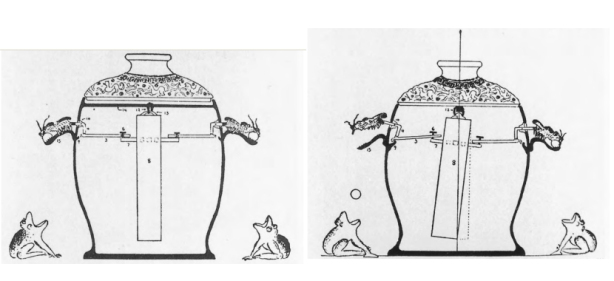
A bronze vessel surrounded by dragons and toads sounds like a decorative object. In accounts of Zhang Heng’s invention, those animals had a practical assignment: announce that an earthquake had occurred.
Zhang Heng described an early seismoscope in China around AD 132. The reported design released a ball from a dragon’s mouth into a toad below, giving a visible and audible indication associated with the direction of the disturbance.
The original instrument has not survived, and the exact internal mechanism remains a subject of reconstruction and debate. Museum models should therefore be understood as interpretations of the historical descriptions. It also was not a modern seismograph recording a continuous trace, and it did not predict earthquakes before they happened. Even with those limits, the ambition is remarkable: build an instrument that detects movement and turns an otherwise fleeting event into a signal someone can inspect.









Add Comment